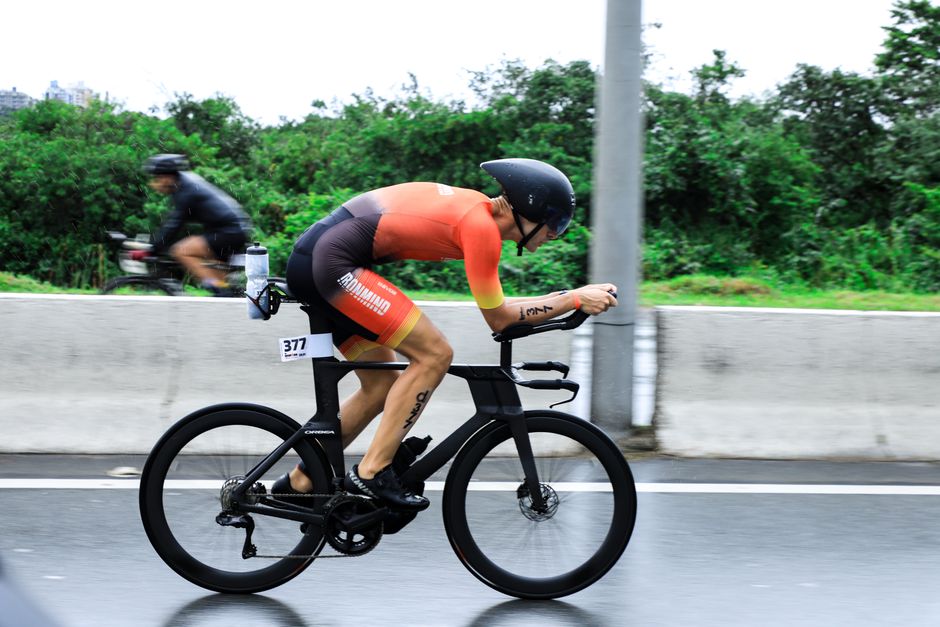
Kristian Blummenfelt's 7:21:24 victory at Ironman Texas hid a much closer marathon than the result suggested. The Norwegian, in his own retelling, was actually behind on the run before producing a controlled but punishing run-down of his rivals.
Blummenfelt described going through the second marathon lap in the chase pack rather than at the front, with Germany's Jonas Schomburg and Belgium's Jelle Geens both attacking the early stages of the marathon hard.
"First of all, it means a lot to take the win against this World Championship field," Blummenfelt said.
"I was really battling out there with Jonas (Schomburg) and Jelle (Geens), going out like rockets on the run."
The Norwegian found himself adrift in the early kilometres of the marathon, by his own admission well off the pace set by Schomburg in particular. The lap one to lap two transition produced his most candid description of the bind he was in.
"I was in the hurt box there, five to ten seconds behind on the second lap," Blummenfelt said.
From there, the strategy changed. Rather than trust a closing kick over the late kilometres, Blummenfelt pushed the pace earlier than he might otherwise have done, hauling himself back into contact and refusing to allow the gap to grow.

"Out there on the final lap, I felt like I had to put pressure on and do whatever I can do to bridge up."
The gear-change was decisive. Blummenfelt's marathon split of 2:30:47 was the fastest of the entire day across the men's professional field — a brutal mark on a course already known for its heat and humidity. By the closing kilometres, Schomburg and Geens were both unable to respond.
Blummenfelt's own assessment of the demands on him was stark.
"If I am not on the gas, I will go backwards on course. The final 5k is always hard."

The statement is a window into the relentless pace the modern Ironman demands of its top contenders. The Norwegian, who has held the Ironman world record at various points and continues to be among the most data-driven athletes in the sport, has previously spoken about his belief that triathlon's marathon should be approached as a sustained tempo effort rather than a strategic build.
The Texas conditions tested that theory. The Woodlands has historically delivered hot, slow finishes, and the depth of the men's field — billed as essentially a World Championship lineup outside of Kona — produced an exceptionally fast first half that put Blummenfelt under uncharacteristic pressure.
For Schomburg and Geens, the result is significant despite the loss. Both men forced the world record-holder into a position he rarely encounters and held him beyond the conventional turning points of an Ironman marathon. Geens, in particular, has been one of the most rapidly improving long-distance athletes on the men's circuit, having transitioned from short-course Olympic-distance racing.
Blummenfelt's own reaction was characteristically grounded. The Norwegian, who took the win and the prize money, refused to overstate the comfort of the result. The hurt box, by his own description, had been a real place. The Texas course had taken him there. He had simply found a way out before his rivals could finish him.
