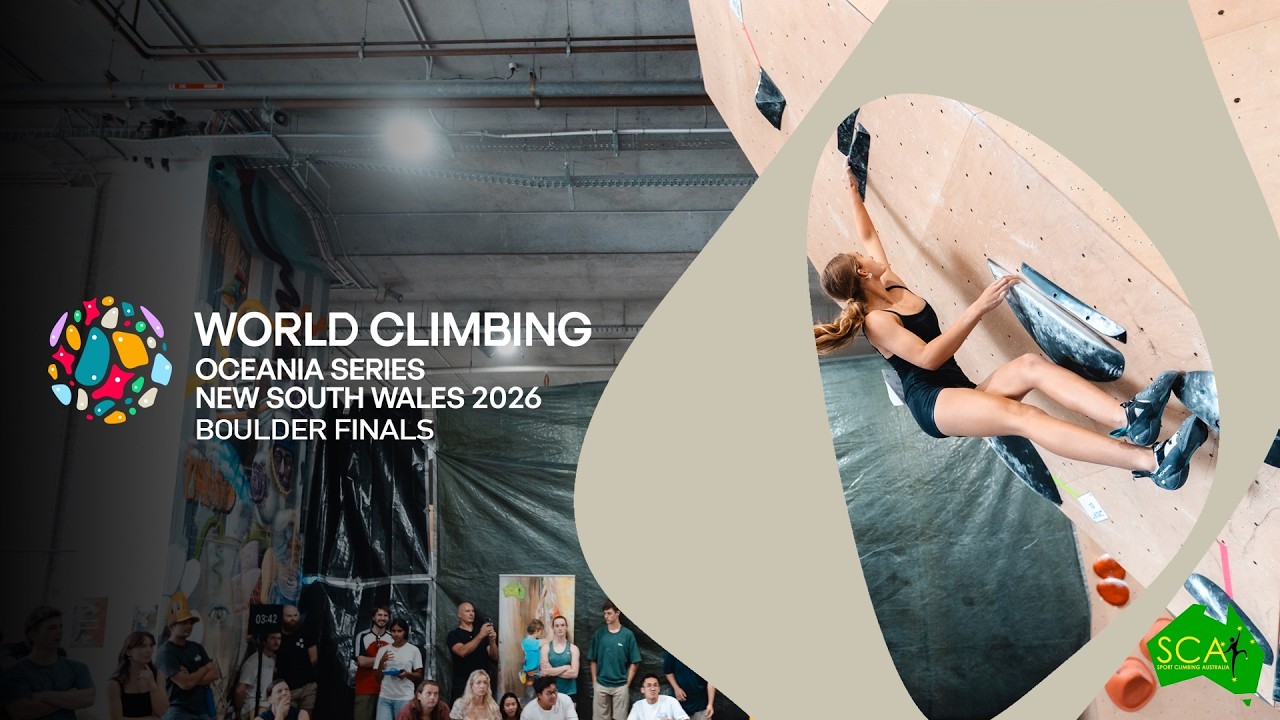
Sam Bowman's jump from 24th in qualifying to fourth in the men's final was the headline climb from the 2026 World Climbing Oceania Series boulder finals at Gladesville, New South Wales � part of a mass reshuffle that saw "pretty much the men's top eight flipped" between rounds, according to the event broadcast.
The Oceania finals pitted nine men's competitors � eight Australians and Luca from New Zealand � against a bracket of brutally set boulders. Aiden led out in reverse qualifying order, with Dylan and the rest of the eight-man Australian contingent following, and Luca anchored the rotation as the sole international entrant.
"We have 10 in the females lineup and nine in the male lineup," the broadcast framed. "Normally we have only eight climbers in the finals. However, we do have Luca all the way from the land of the long white cloud, New Zealand. A big showing here today. He is a competitor in the competition, but he can't take away the national Australian medal."

The numbers behind Bowman's jump shocked the commentary team. "Pretty much the men's top eight flipped. You know, Sam Bowman was in 24. He's now in fourth. I think Dylan and qualified one joint first one two. Couple of big names not making it through to the the finals," one commentator reported during the pre-round scoreboard review.
The partner call added: "Heaps of people that you would expect, and you know, I think four of the top eight didn't make it through from semis to this."
The shake-up reflected the design choice of the event's route setters. The semi-final format had been on-sight � a five-minute first look at each boulder with no beta from other climbers � while the final ran under a different structure that allowed competitors to view all boulders as a group before climbing.
"In this format, it is, you have an opportunity to come out in a group here right at the start and look at each boulder problem for 2 minutes, called the viewing," the broadcast explained. "That'll be an opportunity for everyone to maybe share a little bit of beta or have a little look at some of the moves."

The route-setting difficulty � credited publicly to lead setter Emma Haran � produced brutal margin for error. "In gents, there was one top on boulder two, one top on boulder four. In the women's, I think there was only two tops on boulder two," the commentary team reported of the finals scoring. "They were set to really challenge that upper echelon of the placings."
That scoring environment is the context for Bowman's rise. A climber who doesn't reach qualifying top-eight under standard format can still produce final-round results if the setters design boulders that demand specific physical strengths. Bowman's reported fourth placement suggests exactly that kind of style-match with the finals boulders.
The commentary team also paid tribute to the semi-final field broadly. "The semis, they were on fire," one analyst said. "The quarterfinals, the semis are on fire, and just didn't make it through."
For those who did reach the final, the path to the podium depended on converting the two-minute viewing window into a beta-sharing advantage. The format invites exactly that collaboration, with the commentary calling it "an opportunity for everyone to maybe share a little bit of beta or have a little look at some of the moves and maybe commit some of that to memory."
The Oceania Series falls under the IFSC's recently rebranded World Climbing umbrella. The Gladesville event is the second under that rebrand in the Oceania region, with the broader strategic target firmly on the 2032 Brisbane Olympics. Route-setting calibration at IFSC-affiliated finals is a standing point for venue accreditation going into that cycle, which partly explains why the Gladesville bracket carried the difficulty curve it did.