Max Verstappen delivered an impressive performance during the Japanese Grand Prix, leading the race from start to finish. This victory marked Verstappen's 48th win and solidified Red Bull Racing's sixth Constructors' world title with six races still remaining in the season.
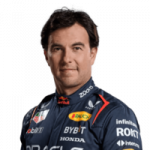
The triumph not only underscores Red Bull's dominance but also hints at their strong position in the Drivers' championship, with only Sergio Perez, who has since retired from the race, posing any threat to Verstappen's title defense. The race podium featured a significant milestone for McLaren, where Oscar Piastri claimed third place, marking his first-ever podium finish, while Lando Norris celebrated his tenth career podium after a hard-fought race.
Mario Isola, the Pirelli Motorsport Director, praised Red Bull's achievements, stating, "First of all, we want to congratulate Red Bull for the goals achieved today: the sixth Constructors' title and the certainty that one of Max or Sergio will win the Drivers' title. The team directed by Christian Horner is characterizing the current era of Formula 1, breaking records after records, and deserves these extraordinary results."
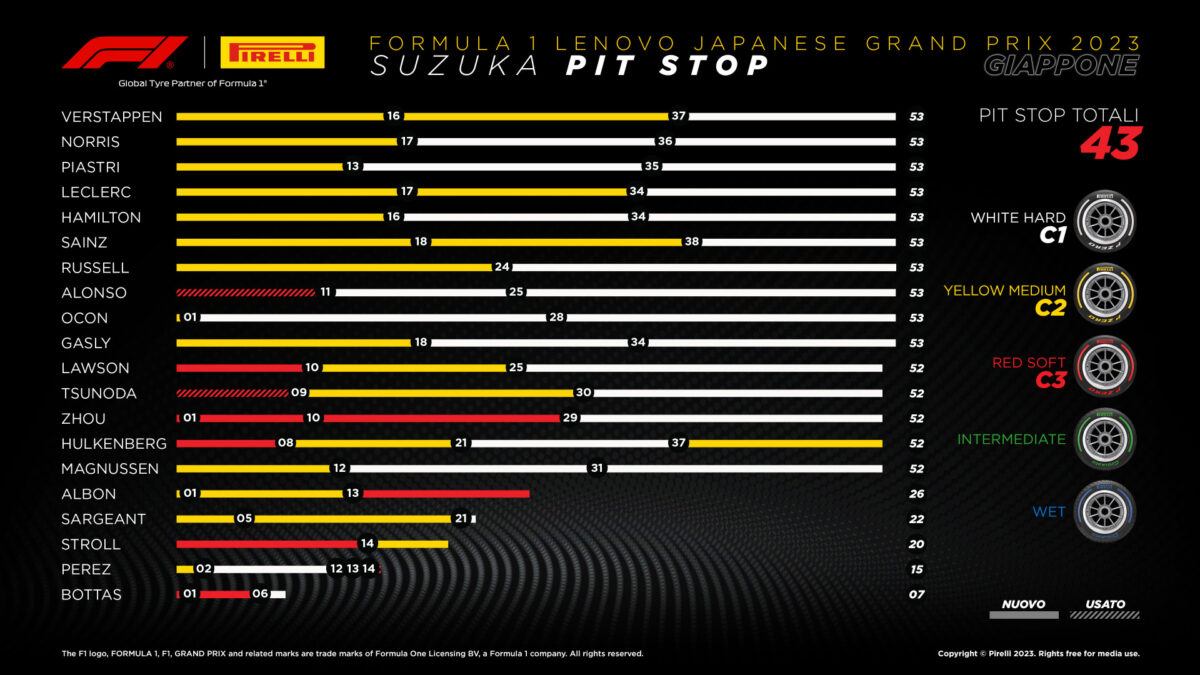
Isola also commented on the challenging nature of the Suzuka track, particularly in high temperatures, stating, "This year we had an additional stress factor in the high temperatures. This afternoon, everything took place according to the predictions made the day before and all three compounds made available to the teams were used, thus creating the conditions for having many different strategies."
Career Journey
The strategic choices of the teams were evident from the start, as thirteen drivers opted for Medium tires at the beginning of the race, while seven chose Soft tires. Despite some early collisions leading to unexpected pit stops, a majority of the drivers aimed for a two-stop strategy, making the most of their tire sets.

**Related:** [Expert Anglers Share Insights on Fly Selection for Successful Trout Fishing](/article/selecting-the-perfect-flies-for-trout-fishing-expert-guide)
Isola noted how this strategy was enhanced by data collected during the free practice sessions. He explained, "After the analysis of the free practice data, we believed that the double stop was the fastest and so it was confirmed: those who, like Russell, rightly tried to do something different, in the end had to give way to their direct rivals who had chosen the double pit stop."
By the Numbers
Russell's strategy involved managing the Medium tires for as long as possible, opting for a one-stop strategy with Hard tires that spanned 29 laps. The Mercedes driver set a record for the most laps completed on a single set of Mediums with 24 laps, while Alfa Romeo's Zhou completed 19 laps on the Softs.

Career Journey
Isola reflected on the tire dynamics throughout the race, stating, "Compared to Friday, we saw how the Medium was used more, even if in terms of degradation the difference with the Soft was not so large today either: clearly the C2 offered greater flexibility in management and this is why it was chosen by the majority of drivers at the start."
The strategic insights from this Grand Prix underline the complexity of tire management in Formula 1 and the importance of adapting strategies on the fly. As the season progresses, the adaptability of teams to the unique challenges posed by various circuits could play a crucial role in determining the outcomes of the championship. Going forward, teams will need to balance performance with tire longevity as they compete for every fraction of a second.