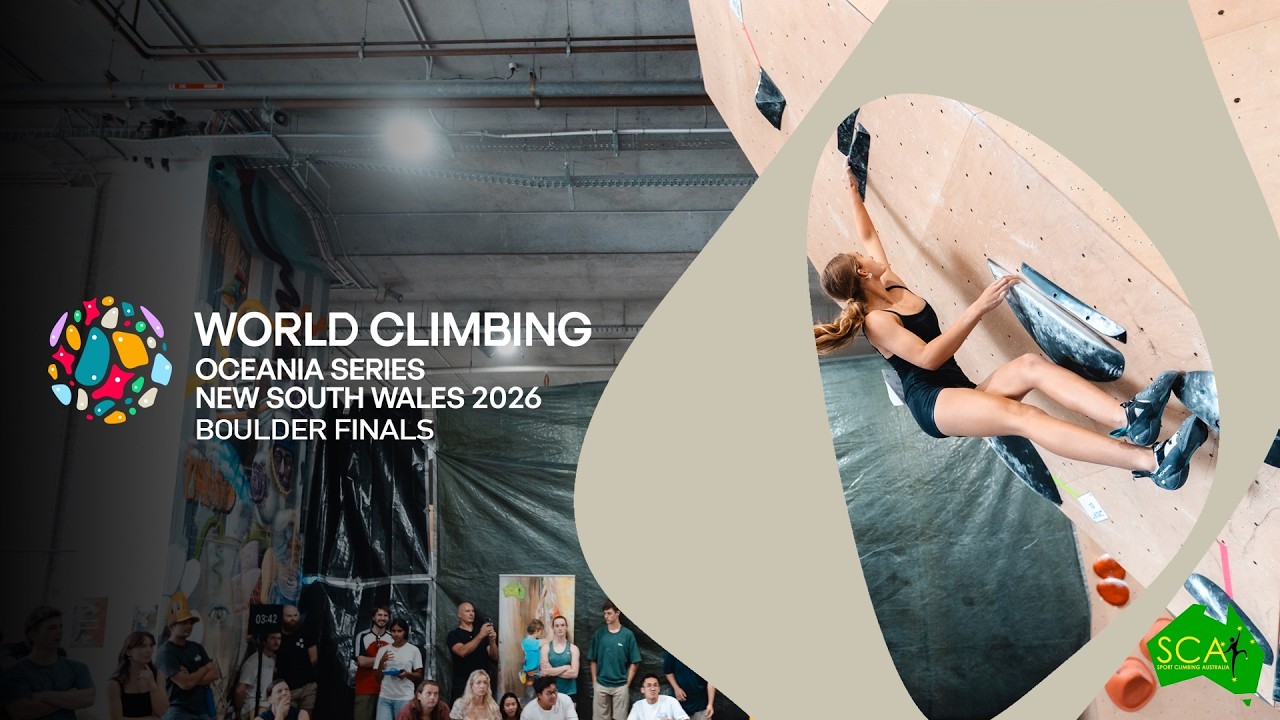
The women's draw at the 2026 World Climbing Oceania Series boulder finals at Gladesville produced a 10-competitor bracket � one larger than the standard eight-climber format � led by Japan's Junko in the top seed and New Zealand's Lucy Sinclair as the standout international entry behind her.
"In your women's lineup, same thing. Junko and Lucy Sinclair from New Zealand. Junko from overseas, Lucy from New Zealand as well. You've got your 10 competitors," the broadcast framed. "Again, they can't take out the Australian championship, but they can place well in the overall competition."
The larger finals bracket reflected the format accommodation for international entries who couldn't claim the Australian national championship medal but could still contest the overall Oceania placement and competition gold. The result was the deepest international field the Oceania series has fielded under its new World Climbing branding.

Junko's semifinal form had already drawn attention from the commentary team. "Junko was incredible earlier," one analyst said of her semi-round performance, setting the expectation that the top seed would carry the form into the final boulders. The semi-final format had been on-sight � five minutes with each boulder, no beta exchange � making Junko's qualifying climb harder to replicate than finals output usually is.
Sinclair's semifinal was equally hard-fought. "Lucy battled it insanely hard," the broadcast partner added. The New Zealander's presence in the Oceania draw is a recurring theme for the region, as climbers from across the Tasman contest the broader series while still holding their national titles separately.
Behind Junko and Sinclair, the final bracket featured two Australian women battling for the national gold � the "top spot and the bragging rights," as one analyst framed it. The commentary noted that while the Aussie national title carried weighted significance, the overall Oceania placement still mattered heavily for international ranking and selection.
"Sometimes that's just as important, right?" the analyst said. "Obviously, nice to get your gold spot and your national title, but yeah, Junko was incredible earlier."
The women's final boulders proved as route-set punishing as the men's. Lead route setter Emma Haran � described by the broadcast as "a bit of a legend of the scene" and "very involved in the Nomad Project" � designed boulders where the top count in both brackets stayed extremely low.
"In the women's, I think there was only two tops on boulder two," the commentary reported. Low top counts at IFSC-level events are a deliberate design choice, forcing differentiation among top-level climbers across partial-zone scoring rather than binary top/no-top outcomes.
The format for finals also gave the 10 women a group-viewing block at the start � two minutes per boulder, all climbers looking together, with informal beta exchange permitted. "That'll be an opportunity for everyone to maybe share a little bit of beta or have a little look at some of the moves," the broadcast explained.
For the region's 2032 Olympic preparation pipeline, the 10-climber women's field is a signal. Oceania women's climbing has historically had narrow depth at elite levels, and a final draw that includes international top seeds alongside national-title contenders helps calibrate competitive standards locally.
Mercedes, identified as a key board member of Sport Climbing Australia, was credited in the broadcast for work on venue and association readiness. "Chatting with Mercedes, one of the key board members, she was very positive about what was going on," the commentary relayed. "It's great to see the sport coming ahead in leaps and bounds."
The women's bracket closed the full weekend at Gladesville � which began with over 20 climbers in the morning semifinals before narrowing to the 10-competitor finals draw. Junko's top qualifying form and Sinclair's battling semi each represented different paths into the finals block, and the final boulder scoring lines were where the Oceania women's hierarchy settled for 2026.