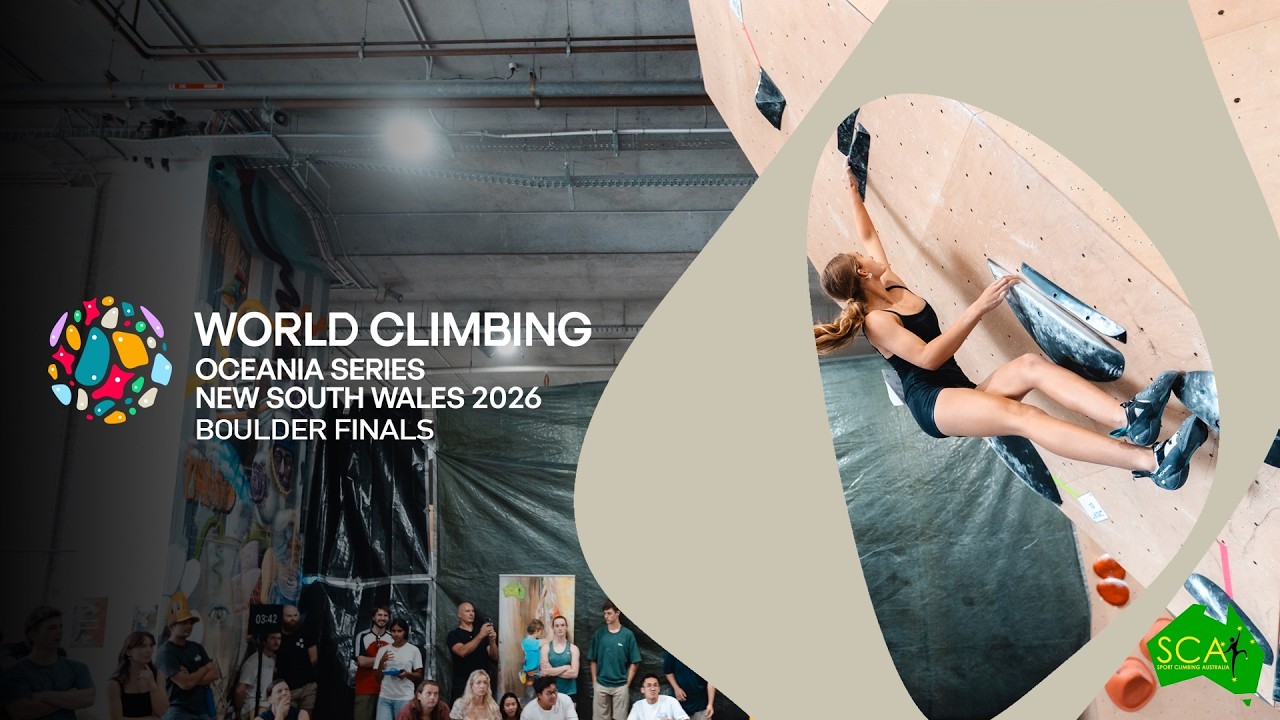
The International Federation of Sport Climbing's rebrand to "World Climbing" has received its Oceania showcase at the 2026 Gladesville finals, only the second Oceania event staged under the new identity, with the region positioning itself as a key development territory ahead of the 2032 Brisbane Olympics.
"The second Oceania competition with this world climbing new rebrand IFSC to world climbing in the Oceania area," the event broadcast framed during the finals introductions. "It's great to see that Australia is stepping up and having international level competitions."
The World Climbing identity retains the IFSC's competition structure � boulder, lead, and speed disciplines plus the combined formats used in Olympic cycles � while updating federation branding, broadcast packaging, and the regional sub-series labels. "World Climbing Oceania Series" is the new regional tag under which Gladesville's Australian National Openers and Oceania championships now sit.

For Oceania, the rebrand lands at a strategic moment. The region's climbing federations, led by Sport Climbing Australia, are in the early stages of a multi-cycle runway toward Brisbane 2032, where climbing is expected to expand its role as an Olympic discipline. Venue accreditation, competitor development and competition format standardisation are all pieces the regional bodies are working in parallel.
"We want to make sure we're able to be ready for the 2032 Olympics, not only the competitors but also the venues and the sports climbing association as well," one commentator relayed of the development work under way.
Mercedes, identified as a key board member of Sport Climbing Australia, received public credit from the broadcast for work on association readiness. "Chatting with Mercedes, one of the key board members, she was very positive about what was going on and it's great to see the sport coming ahead in leaps and bounds," the commentary said.
The new Gladesville gym itself is part of the venue-readiness story. The broadcast repeatedly flagged the facility as "brand new" and a showcase of what Australian climbing infrastructure is now capable of delivering under World Climbing's international-level competition standards.

The Gladesville bracket also brought World Climbing's competition format into local view. Over 20 climbers faced semifinals on Saturday morning, with eight Aussies and one Kiwi (Luca) advancing in the men's, and 10 in the women's. The finals used a group-viewing block � two minutes per boulder, beta-sharing permitted � compared to the semifinals' on-sight format with five-minute individual reads.
Lead route setter Emma Haran, described by the broadcast as "a bit of a legend of the scene" and involved with the Nomad Project, designed a finals block where the gents� field produced "one top on boulder two, one top on boulder four" � a difficulty curve calibrated to split the top-tier placings.
For the live-stream audience, the World Climbing package includes the Oceania bracket's live scoreboard via the World Climbing and Sport Climbing Australia web platforms. "If you do jump on to World Climbing and you can get the live scoreboard up, or against Sport Climbing Australia, there's access to it there," the broadcast directed.
For climbers in the Oceania pipeline, the rebrand carries one key practical shift: eligibility and ranking points across the new World Climbing competition tiers now feed into the IFSC Olympic qualification pathway on unchanged terms. "They can't take out the Australian championship, but they can place well in the overall competition," the commentary described of international entries in the draw.
The second Oceania event under the rebrand produced what the broadcast called "top climbers, top boulderers this year, this moment in Australia." The rebranded World Climbing identity has arrived in Oceania just as the region's own 2032 build-out begins to take shape.