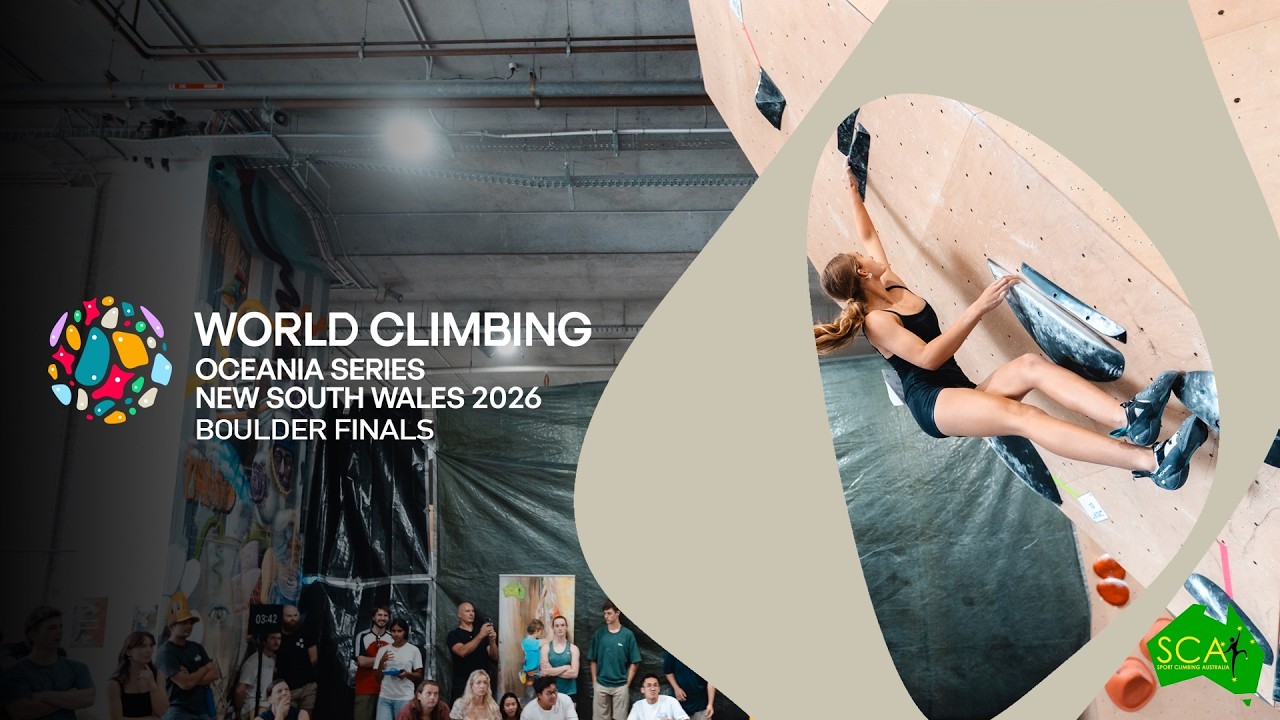
Gladesville, New South Wales has a new climbing gym, and it's already hosted the 2026 World Climbing Oceania Series finals � a role the facility is positioned to build on as Australian climbing works back from the 2032 Brisbane Olympics toward competition-venue readiness.
The broadcast from the Gladesville finals repeatedly flagged the facility as "an amazing climbing gym, brand new down there," and framed it as an example of the infrastructure step-up Australia needs in the lead-up to 2032.
"We want to make sure we're able to be ready for the 2032 Olympics, not only the competitors but also the venues and the sports climbing association as well," one commentator explained during the finals introductions.

The gym's first major event under the World Climbing branding brought over 20 climbers through the morning semifinals, with eight Australians plus one Kiwi in the men's final and 10 women's finalists � the deepest international Oceania bracket to date.
Australian climbing's 2032 roadmap runs along three parallel tracks: competitor development, venue accreditation, and association strengthening. Sport Climbing Australia, the national federation, is driving the effort across all three fronts. Mercedes, described as a key board member of the federation, received public credit on the broadcast for her work on that agenda.
"Chatting with Mercedes, one of the key board members, she was very positive about what was going on and it's great to see the sport coming ahead in leaps and bounds," one analyst said. "An example of that is this amazing climbing gym, brand new down there."
Gladesville's route-setting, led by Emma Haran and described by the broadcast as "a bit of a legend of the scene," produced a finals bracket with margin-testing difficulty. "In gents, there was one top on boulder two, one top on boulder four. In the women's, I think there was only two tops on boulder two," the commentary reported. "They were set to really challenge that upper echelon of the placings."

That kind of route-setting is precisely what the 2032 pipeline needs. The IFSC (now operating as World Climbing) requires venues hosting sanctioned events to meet specific setting-difficulty calibration standards, and hosting events under the new branding gets Gladesville and Sport Climbing Australia closer to the benchmarks Brisbane will need in 2032.
The gym's competition format also delivered two complementary approaches in the same weekend. Semifinals used an on-sight design � five minutes per boulder, no beta exchange � while the finals switched to a group-viewing window allowing two minutes per boulder with beta-sharing permitted. Both formats appear in IFSC event design depending on round and discipline, making Gladesville's dual-format hosting especially relevant for venue preparation.
For spectators, the new facility also opened up improved live-stream coverage. The broadcast directed the online audience to "jump on to World Climbing and you can get the live scoreboard up or against Sport Climbing Australia, there's access to it there" � a digital layer that will be increasingly important for venue bids going into the 2032 cycle.
The finals brackets themselves produced the kind of mid-field reshuffles that IFSC-level route-setting is designed to generate. The men's field saw "pretty much the top eight flipped" between rounds, including Sam Bowman's leap from 24th in qualifying to fourth in the final � a pattern that signals the route-setting is separating climbers on boulder-specific physical strengths rather than just raw strength hierarchies.
Gladesville's role within the broader Australian climbing landscape is still early. The 2032 Brisbane Olympics are six years out, and Sport Climbing Australia's venue development work extends well beyond a single gym. But for the 2026 Oceania Series to land successfully at a brand-new facility � and produce the kind of competition bracket the broadcast commentary called "top climbers, top boulderers this year, this moment in Australia" � is an important early step.
The Gladesville gym has opened its account as a competition venue under the World Climbing banner. The facility's longer-term role as part of Australia's 2032 launchpad now depends on the route-setting calibration, event packaging and live-stream coverage continuing to hold up against international IFSC standards.