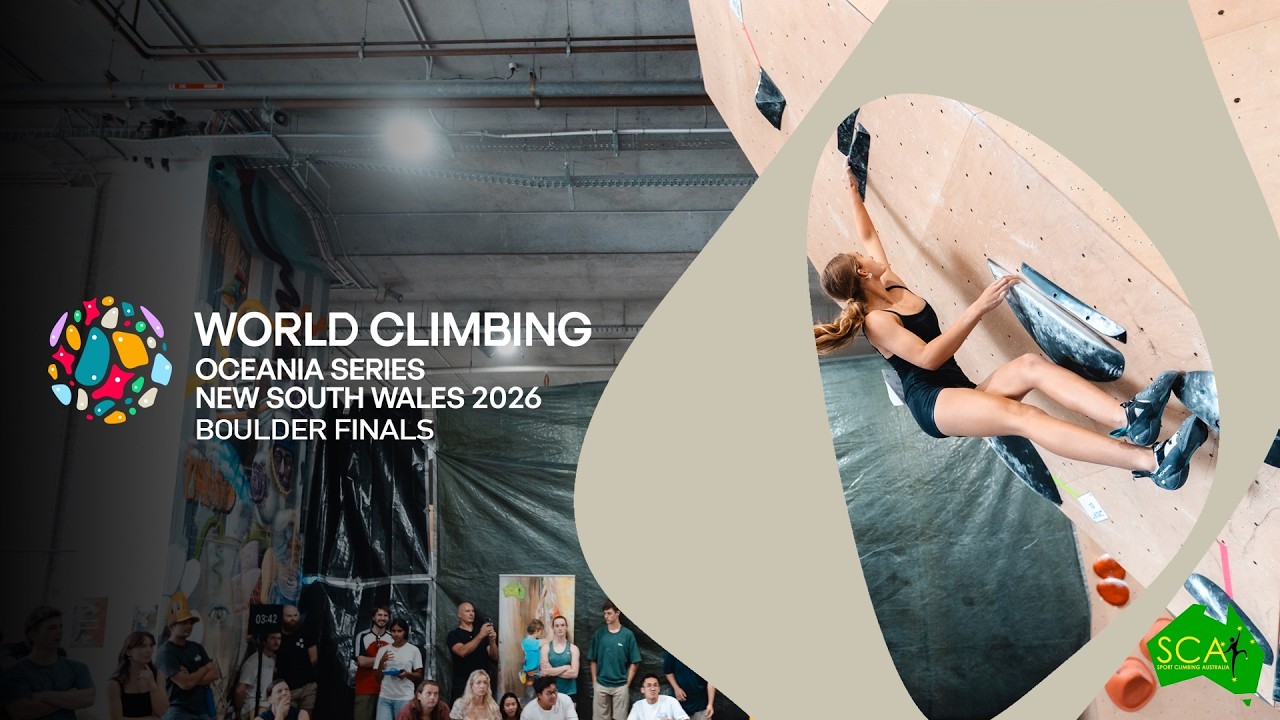
Route setter Emma Haran delivered what competitors and commentators called some of the toughest finals boulders of the 2026 Oceania Series at Gladesville, designing a men's bracket where only one climber topped boulder two and only one topped boulder four across the entire nine-competitor finals field.
"In gents, there was one top on boulder two, one top on boulder four. In the women's, I think there was only two tops on boulder two," the broadcast team reported on the finals scoring. "They were set to really challenge that upper echelon of the placings."
Haran, described on the broadcast as "a fantastic time and actually incredible root set and all bit of a legend of the scene," is also publicly linked to the Nomad Project, a climbing-focused venture. The 2026 Oceania Series finals at Gladesville represented one of the highest-profile recent showcases of her setting work.

Low top counts at IFSC-level events aren't accidents. They are the intended outcome of route-setting calibrated to split climbers along zone-scoring and attempt-count margins rather than binary top/no-top results. When a single climber tops a boulder, the field beneath them is sorted by zones reached, number of attempts, and the speed of completion � producing granular differentiation among elite competitors.
The men's field at Gladesville had nine competitors: eight Australians plus Luca from New Zealand. A finals bracket where four of the boulders produced one or zero tops forces exactly the kind of granular scoring that Haran's setting design targets.
The resulting leaderboard produced major reshuffles from qualifying form. "Pretty much the men's top eight flipped," the commentary reported. "Sam Bowman was in 24. He's now in fourth. I think Dylan qualified one, joint first one two. Couple of big names not making it through to the finals."
The semifinal route-setting had also been credited. "The semis, they were on fire," one analyst said. "The quarterfinals, the semis are on fire, and really just didn't make it through." Haran's team had calibrated the semis to maintain pressure into the finals bracket, where the eight-plus-one lineup could then contest the designed difficulty curve.

The women's bracket mirrored the men's approach. Ten climbers � larger than the standard eight-finalist format to accommodate international entries from New Zealand and Japan � contested boulders where "only two tops on boulder two" was the scoring outcome across the full field.
For route-setters, the two-top ceiling on a women's finals boulder is a technically demanding design target. It requires the boulder to sit above the physical-grade threshold that the top-two climbers can clear on the day, while still holding attempt-based differentiation below the top. That calibration typically depends on knowing the competitor pool's granular physical strengths � something an experienced setter like Haran brings across multiple Oceania-region events.
The finals format supported Haran's setting choices. Competitors had a two-minute group-viewing window at the start of the round, during which beta-sharing was permitted among the finals field. "That'll be an opportunity for everyone to maybe share a little bit of beta or have a little look at some of the moves and maybe commit some of that to memory," the broadcast framed.
The setting's international context matters going into the 2032 Brisbane Olympics. The IFSC's recent rebrand to World Climbing � under which the Gladesville bracket operated � maintains strict setting-difficulty standards for sanctioned events, and hosting an Oceania finals bracket with the kind of low-top count Haran delivered demonstrates that Australian setting work can hold up to international accreditation levels.
The 2026 Gladesville Oceania Series boulder finals will be remembered for several headlines � Sam Bowman's leap from 24th to 4th, the Oceania debut of the World Climbing rebrand, Junko and Lucy Sinclair's international leadership in the women's draw � but underpinning all of them is the setting design Emma Haran and her team delivered. One-top boulders don't happen by accident.