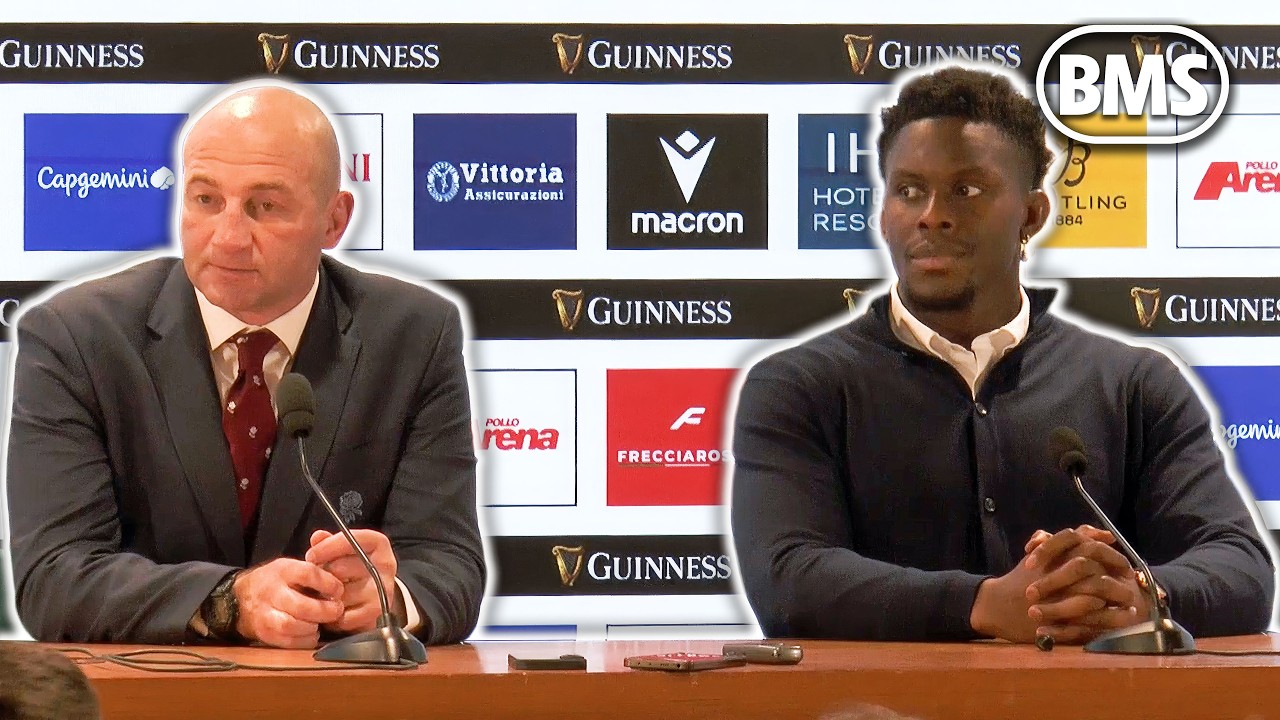
Steve Borthwick had nowhere to hide in Rome, and he did not try to. After Italy beat his England side 23-18 — a third straight Six Nations defeat that lit the largest red flare yet over his tenure — the head coach walked into the post-match press room and put a single tournament-wide statistic at the centre of the conversation: seven yellow cards and a red, across four Test matches.
"What's disappointing in so many ways is around the impact of the the discipline factor of the cards we've had so far for us in this tournament," Borthwick said. "If you look at it, it's not good enough. We've all been very clear and very transparent around it. Is it seven yellow cards and a red card in four games? And the opportunity that gives against quality opposition — I think that ultimately that period at 60, 65 minutes was its key turning point today."
The key turning point Borthwick referenced was the part of the night that, in his own description, hurt the most because it had been gift-wrapped. "At 60 minutes, 18-10, the team's in control of the game," he said. "I would have you go — we're going to scrum 20 metres out from their goal line or 25 metres out from their goal line. They're taking a winger off to put a hooker on. You think: right, this is exactly where we want to be at this point in time. It then goes back to a penalty, three metres from our posts and a yellow card — which is then followed by another yellow card. In that 10 or 15 minutes, the momentum swung, and they were able to get back into the game and ultimately get up on the scoreboard."
Borthwick's broader thesis was that this England side had not been comprehensively outplayed — only outdisciplined. "Today was a different game to the last two," he said. "The last two where we've been down on the scoreboard very early and left ourselves a mountain to climb. Today wasn't like that." Pressed on why the team was now in this position after winning twelve Tests in a row, the coach was direct about the margins. "I think right now you can see, as you've seen with the other result today, teams can beat each other. If you drop off by a period of game by just one or two per cent, then that's when you can get hurt — cuz the opposition are very good."
The coach's most-quoted line, however, was about himself. Asked, for the second consecutive week, whether he was the right man to lead England forward, Borthwick stayed on message but did not flinch. "Yeah, so absolutely," he said. "There's this particular year — the year before a World Cup, the Six Nations before a World Cup — we've seen it before with the England team. You look back to 2018 in particular, and then the team was in a very, very good place for the year, the following year, at the World Cup. It's tough right now. There isn't — there's no doubt about it, we're not hiding away from the fact it's tough. We're not where we want to be in terms of results and in terms of performances."
He credited the playing group for an improved intensity. "I said to you that I didn't think the intensity in the last game was where it needed to be," he said. "I thought that the players, the intensity, was much, much improved — much more like the team. And I said, for 60 minutes I thought the team did a lot of very, very good things today."
Borthwick also opened a deliberate front with the Rugby Football Union, explaining that he and the RFU's senior leadership — performance director Conor O'Shea and chief executive Bill Sweeney — were speaking regularly. "I've been very clear with the RFU, myself, so Conor O'Shea, Bill Sweeney — we speak regularly and discuss about the vision of the team going forward," he said. "They've been very clear in our communication about the long-term vision of the team." The point was not subtle: the RFU was not, on Borthwick's reading, looking for a change.
What would change, however, was the conversation at the team's next training week. Borthwick said he would commit the squad to a deep look at discipline before the round-five visit to Twickenham of France. "What we'll do — as with every one of these experiences — is learn from it and make sure that we are a stronger team going forward," he said. He added a final remark on the long-term vision. "You see the team's growth over the last period of time, certainly the last 12 months — the progress of this has been very, very strong. I think you can see the vision of where the team is going to be, and you see the nature of the players coming through. Right now, this is a tough period."
For Italy, the night was a milestone — a third consecutive Six Nations win when their head coach Gonzalo Quesada has been building exactly the kind of momentum his English counterpart needs. For Borthwick, the night was a public reckoning. He owned the number. He owned the period of the game in which the result was lost. He owned the question of his own future. What he could not own, by Saturday, was a fourth Six Nations win — or a way to explain to a frustrated English public why this current group of players keeps spending the most important 15 minutes of each Test in the sin-bin.
---
*Originally published on [Rugby News Online](https://rugbynews.online/article/borthwick-itoje-england-italy-23-18-seven-yellow-cards-2026). Visit for full coverage.*