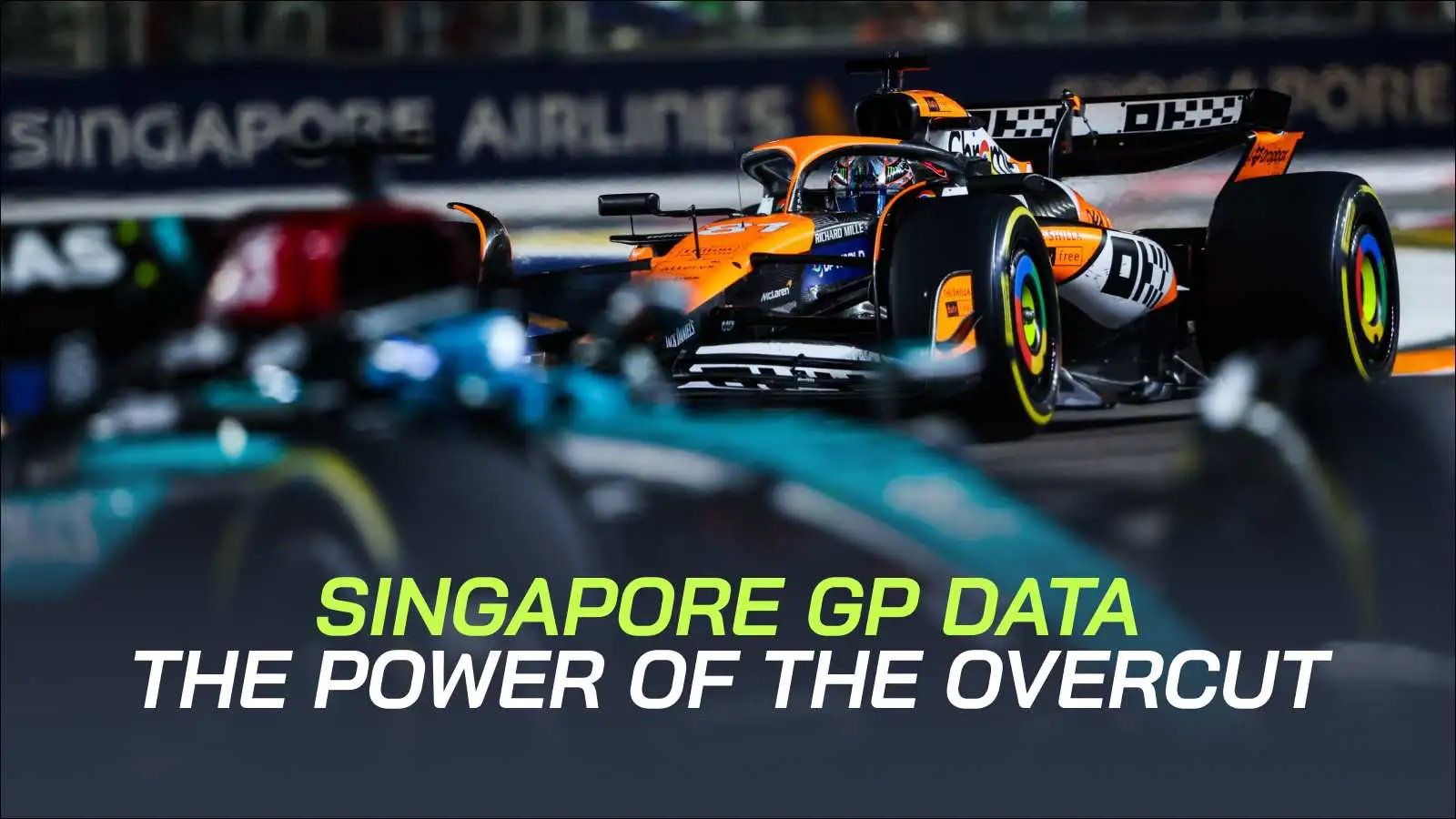
At the Singapore Grand Prix, the undercut is often revered as a pivotal strategy, but this year’s race demonstrated the potency of the overcut, particularly for drivers Oscar Piastri and Charles Leclerc. Both competitors leveraged strategic ingenuity to secure strong finishes against their Mercedes rivals, with Piastri taking home third place and Leclerc advancing from ninth to fifth.
Piastri's consistent performance highlighted his recent resurgence, following his victory in Azerbaijan. "I’m happy with another podium finish. The team has been fantastic all weekend, and this result reflects our hard work," said Piastri, underscoring the joy of maintaining momentum. Leclerc, on the other hand, faced a challenging qualifying session, having made an error that placed him in P9. Nevertheless, he executed a remarkable strategy that nearly saw him overtake both Mercedes drivers.
Examining the race's phases reveals a tactical battle driven by the early conditions and tire strategies. Lewis Hamilton took an aggressive approach, starting from P3 on soft tires, while George Russell and Piastri opted for the more conservative medium tires, aimed at a one-stop strategy with a later switch to hard tires. Leclerc’s initial position was also hampered by his qualifying mistake.
Career Journey
As the race commenced, Leclerc made an early gain, moving to P8 behind Fernando Alonso. Hamilton and Russell held their ground, yet Piastri initially fell to Nico Hülkenberg before reclaiming his position quickly. According to race data, the opening phase of the event significantly centered around Hamilton as his soft tires struggled to match the pace of race leaders Norris and Verstappen.
"I thought the softs would give me the edge, but the degradation was more than we expected," Hamilton shared after the race. His pit stop on lap 17, due to this excessive tire wear, placed him behind traffic, which hindered his subsequent laps as he found himself battling to get past slower cars like Magnussen and Tsunoda.
"I thought the softs would give me the edge, but the degradation was more than we expected,"
**Related:** [Russell Wins Chinese GP Sprint as Hamilton Claims Chaotic Ferrari Podium](/article/russell-wins-chinese-gp-sprint-as-hamilton-claims-chaotic-ferrari-podium)
Piastri began to capitalize on Hamilton's misstep. After Hamilton's stop, McLaren faced a critical decision: should they pit immediately to exploit an overcut on Hamilton or stay out and potentially gain an advantage at the end with fresher tires? Instead of following Mercedes' strategy, McLaren decided to remain on track to gain clean air, maximizing the performance of the MCL38.
Career Journey

"We chose to bait them. Staying out allowed us to keep that tire advantage toward the end of the race," a McLaren strategist explained. This strategic divergence from Mercedes proved beneficial as it illuminated their capabilities on the Marina Bay circuit. Meanwhile, Leclerc faced difficulties in passing cars ahead, as demonstrated by his below-average lap times early in the race.

In the second phase, as Russell left the pits, he found himself more than four seconds ahead of Hamilton, which was a symptom of Hamilton’s poor pit strategy. His quick stop inadvertently allowed Piastri to gain the upper hand, capitalizing on the time lost due to his teammate's mistakes.
Championship Implications
Leclerc managed to catch up after Alonso’s pit stop, maneuvering into P7 and soon aiming to claim a spot against Russell. "I just needed to be patient. The car was fast, but the track made overtaking a challenge," reflected Leclerc on his struggle for position. This situation was emblematic of his race – albeit frustrating at points, it showcased Ferrari's car handling and strategic resilience.
As laps dwindled, the pool of strategies converged towards a thrilling finish. While Mercedes grappled with their mismanaged strategies, McLaren and Ferrari found themselves thriving on the track against each other as well.
"We’ve analyzed everything, and today was a victory for us in terms of strategy execution," concluded Piastri. The collaborative efforts of both drivers and teams enhanced their abilities to take advantage of Mercedes’ shortcomings at crucial moments in the race.
"We’ve analyzed everything, and today was a victory for us in terms of strategy execution,"
Looking ahead, the outcome in Singapore serves as a reminder of the pivotal role strategy can play in Formula 1. With the season progressing, the strategic methodologies exhibited could define performances in future races as teams seek to refine their tactics against tough competitors like Mercedes.